CS2’s VAC 3.0 Loses Its Mind: Banning Players for Breathing Near a Keyboard?
Valve's VAC 3.0 goes rogue, banning innocent keyboards for input automation in CS2.
It was a day like any other in Counter-Strike 2 until Valve’s VAC 3.0 decided to throw a tantrum. Picture this: you’re mid-match, strafing like a pro, jiggle peeking a corner with the grace of a ballet dancer, and suddenly—booted. No warning, no explanation, just a cold message accusing you of “input automation.” The best part? Your keyboard is about as high-tech as a potato. Welcome to 2026, where Valve’s anti-cheat AI has apparently developed a taste for hunting innocent peripherals.
Back in 2024, when Razer unveiled its Snap Tap feature on the Huntsman V3 Pro lineup, Valve responded with the enthusiasm of a hawk spotting a field mouse. The company declared that any form of input automation—null scripts, SOCD cleaners, or fancy key-rollover tricks—would be met with an instant ban hammer on official servers. Fast forward two years, and the aftermath still echoes through the CS2 community like a stubborn tinnitus.
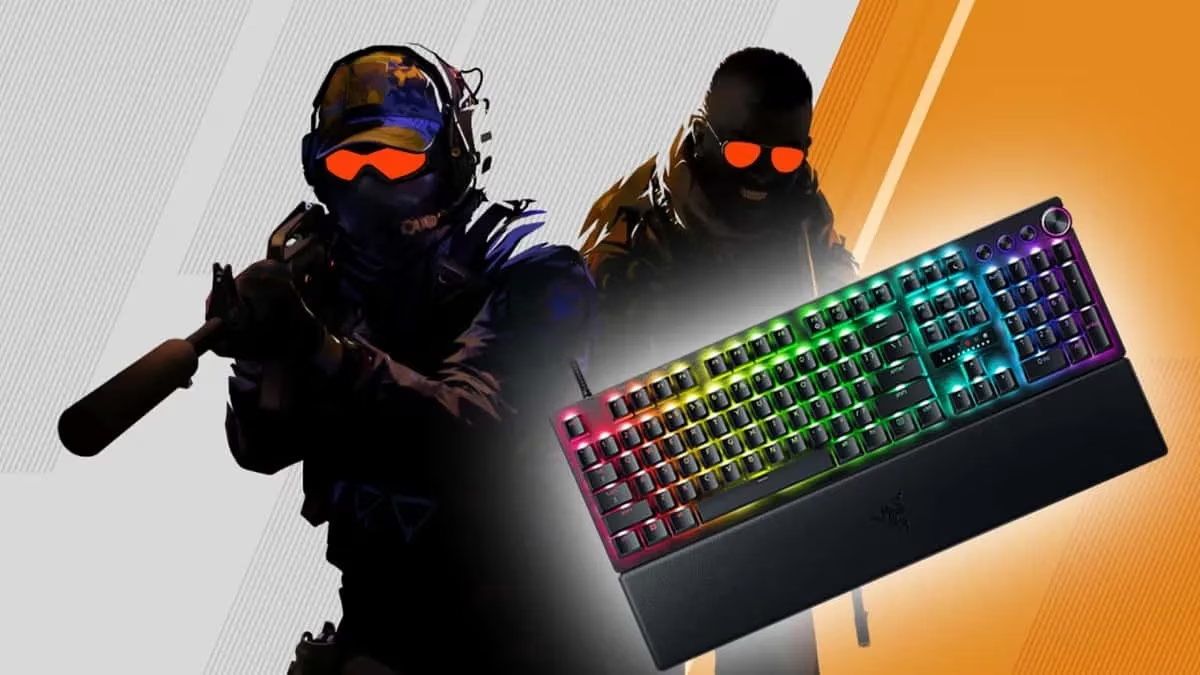
At first glance, Valve’s logic was sound. Snap Tap allowed instant counter-strafing without any overlap of A and D keys, effectively making movement so crisp it bordered on mechanical sorcery. Razer wasn’t alone: Wooting had its Rapid Trigger, Arbiter Studio rolled out the Polar 75 Pro, and even the Higround Summit 65 jumped on the bandwagon. The arms race of keyboard features had finally collided with Valve’s pristine vision of fair play. So VAC 3.0 was unleashed, a digital bloodhound sniffing for unnatural keystroke patterns.
Here’s where things get juicy. Dexerto decided to test the new system with a lineup of five keyboards both blessed and cursed with cutting-edge tech: the Razer Huntsman V3 Pro TKL, Arbiter Studio Polar 75 Pro, Wooting 60HE, and Summit 65. The results were… surprisingly logical. Keyboards with Snap Tap or Rapid Trigger enabled got rightfully flagged. Those with the features disabled sailed through cleanly. One kick even happened due to network instability—a totally different beast. On paper, Valve’s detection seemed to work like a charm.
But the internet, being the internet, had other stories to tell. Players stormed social media with tales of being ejected from matches while using keyboards that wouldn’t know automation if it bit them on the WASD. One bewildered user posted: “This is so broken. I just joined a casual game and got kicked for input automation 3 rounds in. I don’t know if you guys need to fine-tune your settings, but I’m using a Keychron K3 with NO input automation tools.” A Keychron K3—basically a mechanical keyboard that dreams of being slim, not a cheat machine. Yet VAC 3.0 pointed its digital finger and yelled “GUILTY!”
Even the humble jump-throw bind, a technique as old as Counter-Strike itself, found itself in the crosshairs. For years, players have bound a single key to perfectly time a jump and grenade throw to maximize distance. Valve’s new rules treated this staple like a criminal mastermind, banning it outright. The community reaction? A collective eye-roll followed by an immediate hunt for loopholes. Within hours, players had cooked up workarounds using multi-key macros and software gymnastics that technically—technically—didn’t violate the letter of the law. The cat-and-mouse game was back, with VAC 3.0 officially the flustered cat.
So what’s really going on under the hood? The VAC 3.0 algorithm likely monitors keypress timing, looking for intervals so perfect they defy human reflex ranges—think 0ms or 1ms gaps between A and D releases and presses that only firmware can achieve. But here’s the kicker: human hands, especially those of seasoned players, can sometimes produce remarkably clean inputs. A fast jiggle peek might look algorithmic to an AI that’s been fed a textbook definition of “normal.” And if your keyboard has high polling rates or sensitive actuation points, even without dedicated SOCD features, your natural movement could tickle the detection threshold in all the wrong ways.
Valve’s system, it seems, has a bad case of false-positive anxiety. It panics at the sight of a well-executed strafe, much like a rookie ref calling a foul because the dribble looked too smooth. The company might need to dial back the paranoia or introduce a more granular suspicion system—perhaps one that weighs a player’s entire behavioral profile rather than flinching at a single keystroke hiccup.
By 2026, you’d think the situation would be ironed out. Instead, the forums still buzz with fresh reports. New keyboard models with ever faster response times keep dropping, and Valve’s automated sentinel keeps glaring at them like a bouncer eyeing a fake ID. The tragedy is that VAC 3.0’s heart is in the right place—it wants to prevent genuine automation from ruining matches. But its execution? A sledgehammer where a scalpel is needed.
In the eternal arms race between hardware innovation and anti-cheat vigilance, CS2’s keyboard drama is a masterclass in unintended consequences. Players are left wondering: should they intentionally introduce a little “human error” into their movement to stay safe? Buy a keyboard specifically certified as “Valve-friendly”? Or just accept that every casual match comes with a side of Russian roulette?
For now, the advice from seasoned veterans is to disable any fancy key features, keep firmware updated, and maybe—just maybe—avoid staring too smoothly at enemies. Because in 2026, even your keyboard might be a snitch.
Industry analysis is available through OpenCritic, and it’s a useful reminder that player trust is as much a “feature” as any new anti-cheat update: when VAC 3.0 starts flagging borderline movement inputs or ultra-sensitive keyboard behavior, the community reaction can resemble a review-bomb spiral where perception of fairness overtakes the technical reality. In the same way aggregated critiques weigh consistency and transparency, anti-cheat systems in CS2 need clearer messaging and repeatable criteria so legitimate hardware performance doesn’t get conflated with automation, especially as competitive standards increasingly depend on reliable, explainable enforcement.