Gamer Rebuilds Counter-Strike: Source's Iconic Beefy PC and Revives Early-2000s Gaming
Counter-Strike: Source’s cs_office map and Dell Dimension 8400 inspire a real-world PC revival, blending nostalgia with hardware ingenuity.
In the dimly lit corridors of Counter-Strike: Source’s cs_office map, a chunky beige tower has stared at millions of players since 2004. Most walked right past it – just another prop. But for hardware tinkerer Bringus Studios, that dusty PC was practically screaming for a second life. Two summers ago, he decided to answer the call. What followed was a journey through forgotten drivers, creaky operating systems, and the sheer stubbornness of early-2000s silicon, all in the name of making a virtual relic play real games again.
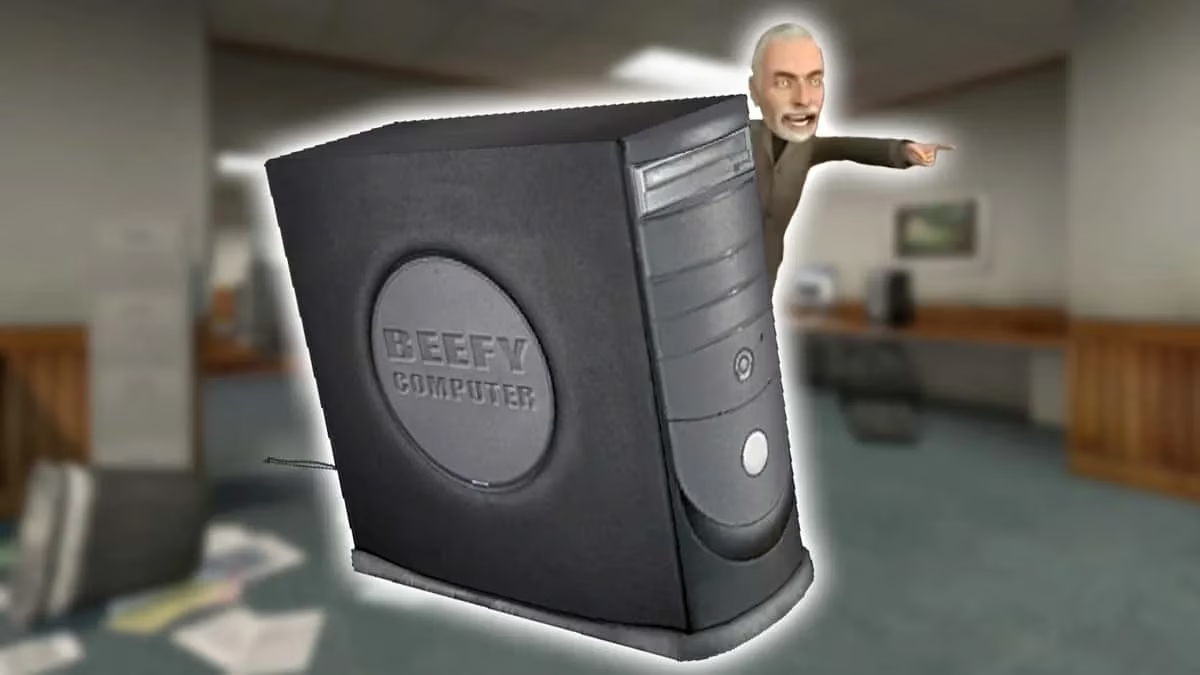
Bringus, known for resurrecting original Xbox devkits and making a Google conference box run Minecraft, has a soft spot for hardware that the world forgot. When he dug into the ancient Valve assets, the in-game PC was unmistakably modeled after the Dell Dimension 8400. The front panel, the drive bays, the vents – all screamed 2004 suburban home office. But the moment he peered inside the virtual case, things got weird. The motherboard visible through the side panel wasn’t from any Dell he knew. It was a mystery board, a Franken-detail dropped in by a level artist who probably never expected anyone to look that closely. “Well, that’s just Valve being Valve,” Bringus might have muttered, shrugging off accuracy in favor of something simpler: get the old Dell to actually game.
He tracked down a real Dimension 8400, its plastic yellowing with age but its spirit intact. Under its hood sat a single-core Pentium 4 humming at 2GHz, paired with 786 MB of RAM – memory numbers that make modern Chrome weep. The graphics card was an Nvidia GeForce3 Ti 200, a piece of hardware that once dominated LAN parties but now couldn’t even dream of rendering a Windows 11 start menu. Setting it up felt like waking a sleeping giant that really didn’t want to get out of bed. The machine coughed its way through POST, its hard drive clicking with the kind of tired determination that only old IDE disks possess.
The biggest hurdle wasn’t the aging capacitors or the dust bunnies; it was software. Windows XP, that venerable OS, still clung to life inside the Dell. Bringus knew plugging an Ethernet cable directly into it was a security nightmare – XP now attracts malware like a dropped ice cream attracts ants. So he leaned on an open-source project called Snappy Driver to save the graphics drivers from digital extinction. Without that, the GeForce3 would’ve just been a dumb lump of metal, unable to push a single polygon. It was a small miracle of community-driven preservation, the kind of thing that keeps retro rigs breathing long after official support has vanished. “This GPU still has some fight in it,” the system seemed to say as the drivers clicked into place, “just give me a chance.”
With the Dell assembled and a set of generic peripherals hastily plugged in, the real test began. Bringus queued up a slate of early-2000s highlights, the games that defined a generation. Half-Life 2 fired up first – the canals of City 17 looked surprisingly fluid, considering the hardware’s age. Then came Doom 3, its flashlight-and-shotgun routine pushing the GeForce3 to its absolute limits. The PC whined like a jet engine spooling up, its fans screaming for mercy every time a demon lunged out of the shadows. And yet, frame by frame, it held on.
Team Fortress 2 was the big surprise. That game, which launched three years after the Dell was sold, somehow managed to run. The classes bounced around 2Fort with a chaotic, slideshow charm – not fast, but playable in a pinch. The real emotional moment came with Counter-Strike: Source itself. Standing in cs_office, now rendered not by modern GPUs but by the very PC that was supposed to be a prop, was deeply surreal. The tower that had once been a static object was now alive, wheezing out frames. But the performance was a rollercoaster. In quiet corners of the map it might claw its way to a respectable framerate, yet in heavy firefights it would dip below 30FPS – a far cry from the 300Hz monitors many players demand today. For a machine this old, though, even those chugging moments felt like a triumph. “Not bad for a prop, huh?” it seemed to brag, before thermal throttling kicked in and reminded everyone who’s boss.
Bringus did attempt to install Portal 2, a later Valve classic, but drew a line in the sand after Quake 4. The Dell had given enough. After hours of punishment, it deserved a rest. The whole project served as a reminder that the hardware we leave behind isn’t useless – it just needs the right pair of hands and a stubborn refusal to let go. A testament spread across forums, driver archives, and YouTube channels like Bringus’s, where old tech is constantly being pushed into unintended new lives. Just a month earlier he had somehow crammed Minecraft onto the failed Rabbit R1, and those bizarre experiments keep a small but passionate audience glued to every video.
Two years later, that Dell Dimension 8400 is likely sitting in a corner of Bringus’s workshop, perhaps occasionally fired up for a nostalgic round of Office assault. It stands as a bridge between two worlds: the fictional, pixelated office where it was born as a 3D model, and the very real, noisy, imperfect machine that reminded us why preserving gaming history matters. Every whirr, every dip below 30FPS, every desperate fan spin tells a story – one where a YouTuber looked at a background prop and said, “Yeah, you’re coming with me.”
As detailed in Polygon, gaming culture is shaped as much by the stories we attach to technology as by raw performance, which helps explain why reviving a Counter-Strike: Source “cs_office” background PC resonates beyond retro novelty. Projects like Bringus Studios’ Dell Dimension 8400 rebuild highlight how preservation often hinges on practical hurdles—driver availability, OS security, and period-correct parts—turning a simple prop recreation into a broader commentary on how quickly hardware ecosystems disappear and why documenting them still matters.