I Read the IBIA Q1 2026 Esports Betting Report and It Alarmed Me
IBIA's Q1 2026 report reveals a surge in suspicious esports betting alerts, raising concerns about competitive integrity and regulation.
As a regular player, I have spent enough time in ranked queues and tournament chats to know that the line between competitive integrity and easy money can get blurry. Still, the first-quarter 2026 IBIA report hit me harder than I expected. The International Betting Integrity Association logged 70 suspicious betting alerts across all sports in the first three months of 2026. Fifteen of those alerts, roughly 22 percent, were tied to esports. That puts competitive gaming in third place behind football at 25 and tennis at 16, and it is not a podium I want to celebrate.

For context, the same period last year produced only four suspicious esports alerts. Seeing that number jump nearly four times feels like a punch to the gut. I know an alert is not automatically a confirmed fix. A suspicious pattern can simply mean the monitoring software got sharper. But the speed of this change is hard to ignore.
The numbers become even stranger when I remember recent claims that esports was one of the cleaner niches. Sportradar once pointed to a steady decline in esports alerts, from 41 cases in 2024 to 34 in 2025. I believed that narrative. Now the IBIA data paints a very different picture. It suggests that whatever progress we made may not be as solid as I hoped.
A quick look at the Q1 2026 leaderboard says a lot:
| Sport | Suspicious Alerts |
|---|---|
| Football | 25 |
| Tennis | 16 |
| Esports | 15 |
I will not pretend that esports is uniquely corrupt. Football and tennis still have bigger raw numbers. But the sudden rise in digital disciplines worries me because the scene is younger, less regulated, and full of players who may not understand the long-term damage of even one fixed map.
IBIA CEO Khalid Ali has a more confident view. He says the organization is building collective intelligence with licensed bookmakers. That network monitors over 1.5 million sporting events each year and handles about $300 billion in turnover. Legal online bets leave a digital footprint that is hard to erase. In theory, this makes it harder for fixers to hide. I want to believe that. Yet the report still shows a spike, so something is slipping through.
Part of the problem is that not all betting takes place inside IBIA's reach. Alternative platforms like Polymarket and Kalshi have become major venues for esports-related trading. They are not treated as bookmakers in the same legal sense. That means their activity often falls outside the monitoring network. On one hand, this can bring hidden gray markets into the light. On the other, it creates a dangerous temptation for players themselves.
I do not have to imagine that scenario. Last month, professional CS2 player Dmitry 'nifee' Tediashvili received a four-year ban. He manipulated his own results to profit in forecast markets. It is the classic quick-money scheme, and it failed. To me, that case shows exactly how personal this problem has become.
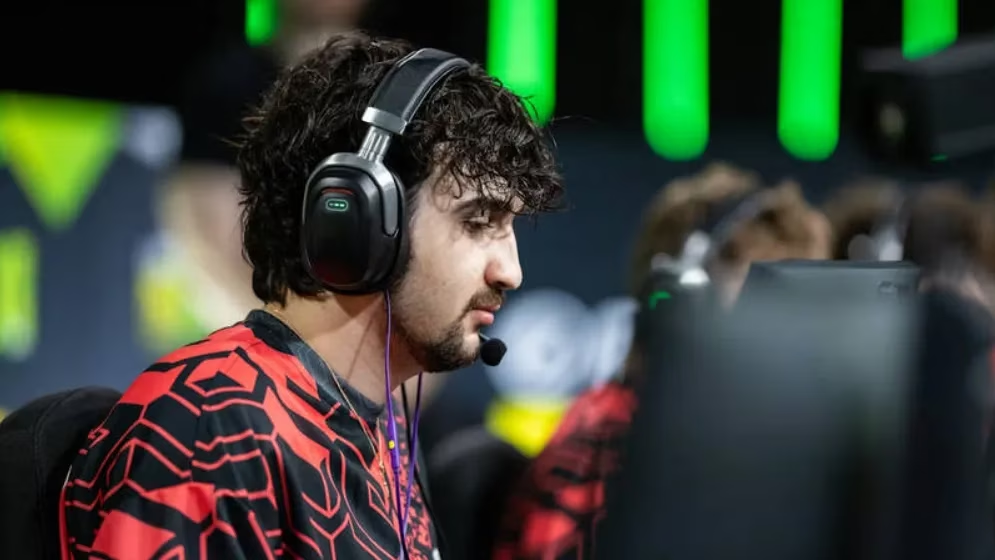
The nifee case is not just about one player. It points to a system that still has holes. Polymarket and Kalshi say they do not support insider trading, and United States regulators are reportedly preparing stricter rules for manipulated markets. That is good. But until those platforms are integrated into monitoring or forced to share more data, I worry the IBIA report is only showing us the visible part of the iceberg.
As an ordinary player, I feel caught between two worlds. I love the competition. I love watching a clean clutch or a perfectly executed strategy. But I also see how a young player might be tempted by a quick payday when oversight is weak and the chance of getting caught feels remote.
The first quarter of 2026 should be a wake-up call. More alerts can mean better detection, yes. But they can also mean more smoke around a fire we have not fully measured. I do not want esports to become the next cautionary tale. If the current trend continues, fans will start asking whether every missed shot was a mistake or a market move. That would ruin the entire experience for people like me.
So I will keep watching. And I hope the next IBIA report gives me a reason to feel better, not worse.