Lifeweaver's Impact on Overwatch: Abilities, Hitbox Controversy, and Meta Evolution
The arrival of Lifeweaver in Overwatch 2 sparked debate over his oversized hitbox and low health, prompting ongoing balance adjustments.
The arrival of a new hero in Overwatch 2 has always been a catalyst for sweeping changes, forcing both casual and professional players to reevaluate strategies and team compositions. Among the most discussed additions in recent years is Lifeweaver, a support hero whose botanical toolkit promised to reshape the battlefield. Introduced during Season 4 in April 2023, Lifeweaver immediately sparked conversations that extended far beyond his healing capabilities. While his flower-based abilities introduced novel mechanics, it was his physical proportions—specifically the size of his hitbox—that dominated early discourse. Years later, in 2026, the story of Lifeweaver serves as a compelling case study in hero design, community feedback, and ongoing balance tuning.
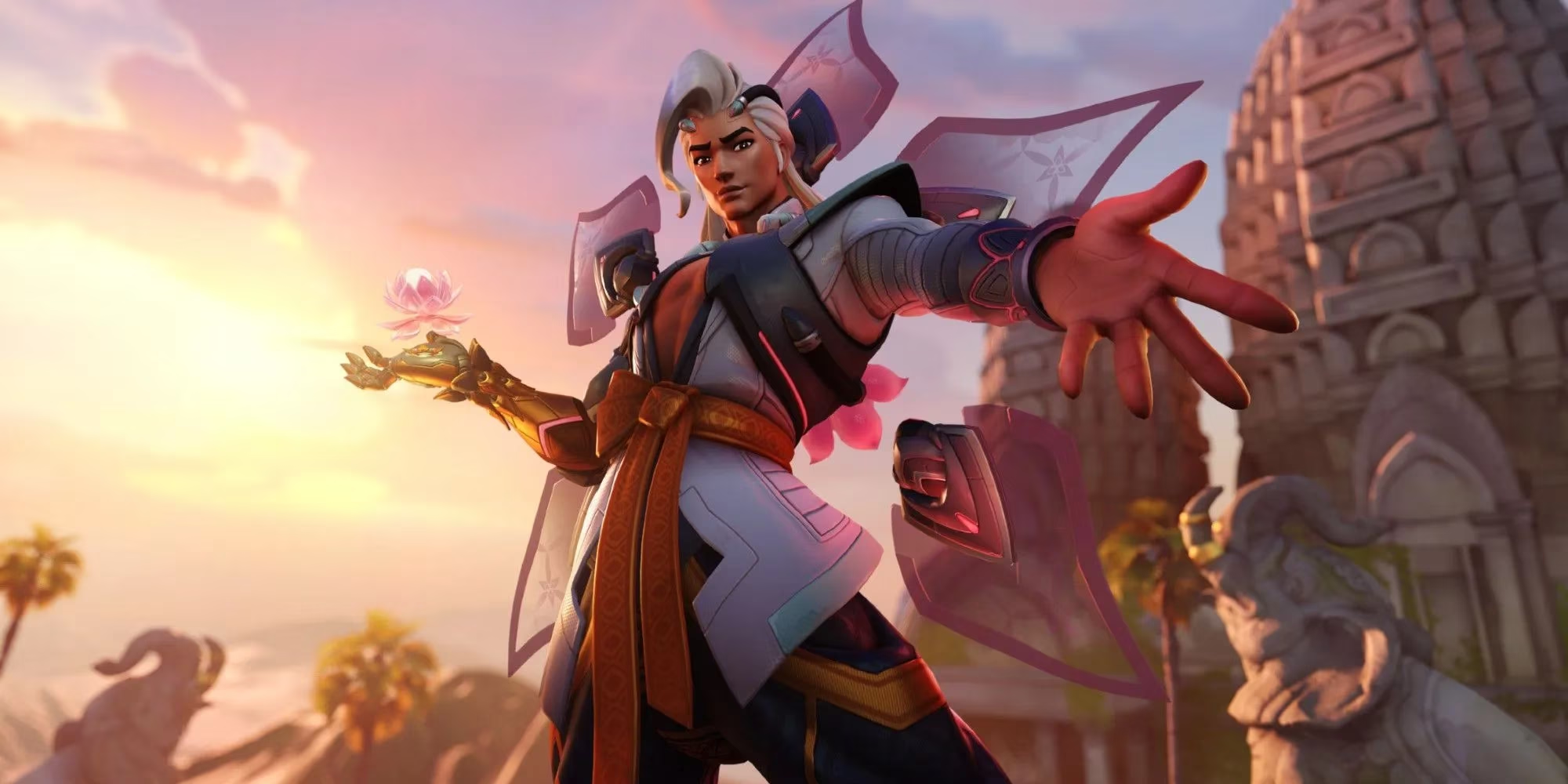
Lifeweaver entered the roster as a versatile support, adept at both sustaining teammates and contributing offensively. His primary healing method, Healing Blossom, allowed precise single-target restoration without requiring precise aim, functioning similarly to a soft-lock system. On the offensive side, he could switch to Thorn Volley, a spread attack that dealt respectable damage for a support hero. This dual-firing mode gave him flexibility in engagements, but his true distinctiveness lay in his utility. The Petal Platform ability created a vertical lift that could elevate any ally, enabling creative positioning, escape routes, and high-ground access previously unattainable for certain characters. His Life Grip, perhaps his most controversial tool, pulled a targeted teammate toward him while bestowing a brief protective barrier. Topping off his kit was the ultimate ability Tree of Life, a deployable structure that emitted pulses of healing over time in a wide radius, effectively anchoring team fights.
Despite these innovative features, the community’s immediate focus fell on Lifeweaver’s survivability. Standing at a height comparable to Ramattra or Junker Queen, Lifeweaver boasted a slender frame but with an enlarged silhouette due to the massive petal-like ornaments on his back. Players quickly noted that his base health pool sat at a mere 200 HP with no shield or armor components. This contrasted sharply with other large heroes: Ramattra and Junker Queen each possessed 450 total hit points, and even the relatively compact Zenyatta and Symmetra benefited from shields. The result was a support hero who was exceptionally easy to target, especially by hitscan snipers and agile flankers. A glance at early community reactions captures the concern: “Snipers and flankers are going to give him an extremely bad time,” one player remarked. The same analysis highlighted that Sombra could hack Lifeweaver’s Petal Platform to destroy it instantly and use EMP to obliterate the Tree of Life, severely limiting his utility. Another player added that without the back petals counting toward his hitbox, 200 HP might have been acceptable, but the current bulk reminded many of Bastion—a damage hero who received extra HP and armor precisely because of his larger frame.
The backlash did not go unnoticed. Within the first weeks of Season 4, Blizzard Entertainment acknowledged the feedback and implemented a series of adjustments. Lifeweaver’s health was increased from 200 to 225, a small but meaningful change that gave him slightly more time to react to threats. More significantly, his hitbox was refined so that the decorative petals on his back no longer inflated his vulnerable area to the same extreme. In subsequent patches, additional quality-of-life improvements were made: Healing Blossom received a faster charge rate, Life Grip’s cooldown was reduced, and Tree of Life’s healing output was tuned to keep pace with higher damage environments. These iterative changes reflected a developer philosophy geared toward making the hero feel responsive rather than frustrating, without overbuffing to the point of dominance.
Looking at the current landscape in 2026, Lifeweaver has settled into a specialized, high-skill-ceiling role that rewards map awareness and team coordination. He is frequently picked on maps with significant verticality, such as Dorado, Rialto, and Circuit Royal, where Petal Platform can create vantage points for Ashe or Sojourn. His pairing with heroes vulnerable to dive, like Ana or Zenyatta, allows Life Grip to serve as a crucial peel tool that denies enemy engagements. At the professional level, teams have built entire compositions around Lifeweaver’s ultimate, using Tree of Life to sustain aggressive pushes or counter gravitic combos. However, he still demands careful positioning; a Lifeweaver caught out of cover remains a prime target for Widowmaker, Hanzo, and flanking Tracer players. The initial design tension—blending a large silhouette with a support’s fragility—has not fully vanished, but it creates a risk-reward dynamic that defines high-level play.
The evolution of Lifeweaver also prompted wider discussions about hero identity in Overwatch 2. Unlike the original game’s more uniform support class, the sequel’s design trend towards unique, sometimes polarizing abilities reflects a desire to diversify playstyles. Lifeweaver’s introduction taught the community that size and survivability must be balanced not only by raw numbers but also by how a hero’s utility can circumvent incoming damage. His journey from a seemingly overtuned hitbox disaster to a nuanced meta figure illustrates the delicate interplay between player perception, data-driven balancing, and the creative risks developers are willing to take. For players revisiting his career, Lifeweaver remains a testament to the fact that even the most contentious launches can lead to enduring additions, provided the studio listens and iterates.
In retrospect, the early fears about Lifeweaver’s viability have largely given way to respect for his mechanics. He may not have become a universal main, but his presence continues to enrich the tactical fabric of Overwatch 2, reminding everyone that in a game of shifting metas, innovation often arrives with petals and thorns alike.