My $2 Million CS2 Capsule Hoard: The Unrealized Fortune I’ll Never Sell
My CS2 inventory's $2M hoard of EMS Katowice 2014 sticker capsules proves long-term virtual item investment pays off.
The faint hum of my PC fans fills the room as I click through the familiar tabs of my Counter-Strike 2 inventory. I’m not looking for a new play skin or admiring a recent unbox — I’m visiting the vault. Not many people have seen this part of my storage, and even fewer understand why I’ve let it gather digital dust for years. As the grid loads, my chat explodes with a cascade of emojis: 💎💎💎. I’m scrolling through my most precious unit, bluntly labeled “random stuff 2,” and there they are — rows of pristine EMS Katowice 2014 Sticker Capsules, each one a time capsule from an era when virtual items were just collectibles, not investments. Today, in 2026, the total value of what’s sitting in this storage unit has crossed the two-million-dollar mark, and I’m still not selling a single capsule.
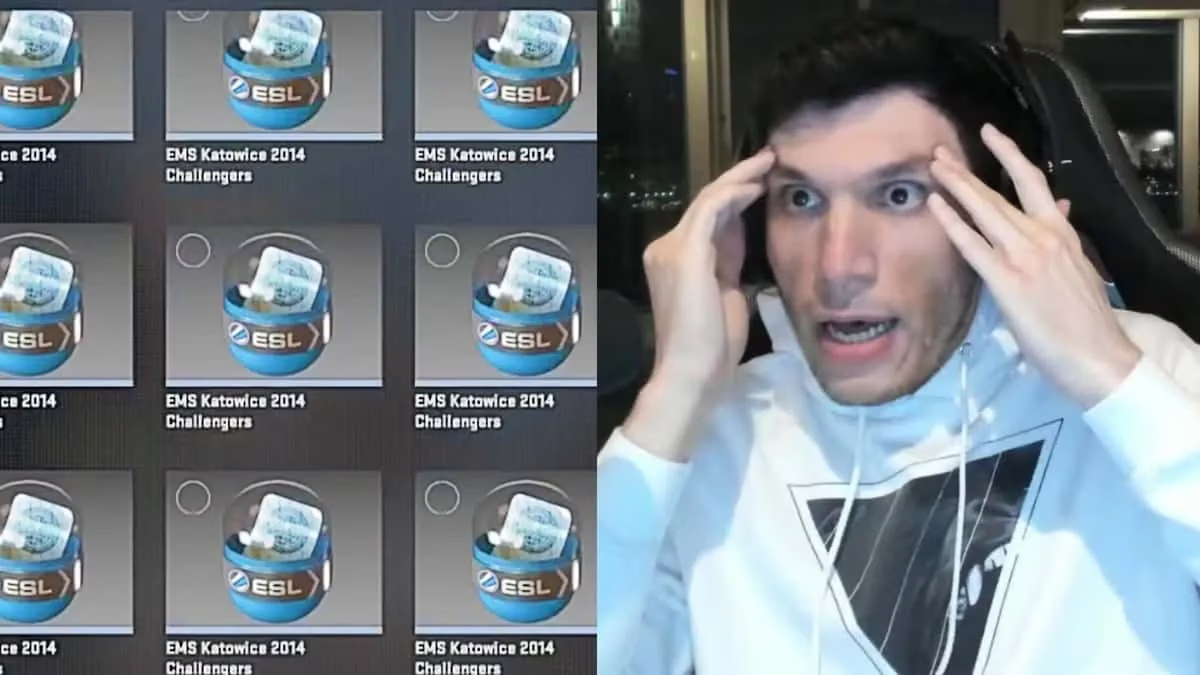
It’s surreal to think that this collection started almost with a shrug. Back in early 2020, I was already deep into the Counter-Strike skin economy, flipping knives and gloves for small margins while streaming my competitive matches. But I had a rule: I never bought skins outright. Everything in my loadout had to be unboxed, earned in a drop, or won in a community tournament. That purist approach made me ignore the burgeoning capsule market for ages — until a friend who knew the ins and outs of steam trading whispered a piece of advice that would alter my digital net worth forever. “If you really want to print money, stack Katowice 2014 capsules. Don’t open them. Just hold.” I started acquiring them one by one, then in small lots, often funding each purchase through the sale of less sentimental playskins. By the time CS2 launched in 2023, I had already amassed a hoard of 66 EMS Katowice 2014 Capsules — a number that would swell to 72 by the end of 2024, and has since grown even further.
The inventory speaks for itself. Let me break it down for the curious minds:
| Item | Quantity | Approx. Value per Unit (2026) | Total Estimated Worth |
|---|---|---|---|
| EMS Katowice 2014 Sticker Capsule | 72 | $20,000 – $22,000 | ~$1.5 million |
| Titan Holo (Katowice 2014) | 3 | $68,000 – $72,000 each | ~$210,000 |
| Katowice 2014 Souvenir Packages (assorted) | 14 | $2,000 – $3,500 per package | ~$35,000 |
| London Conspiracy (Holo) & other 2014 team stickers | 8 | $15,000 – $30,000 combined | ~$180,000 |
And that’s just the capsule-adjacent stash. The sticker capsules themselves are the crown jewels. In 2023, a single EMS Katowice 2014 capsule changed hands for around $12,000. By 2024, as the reference snapshot showed, the price had climbed to the $18,000–$20,000 range. Now, in 2026, after another wave of new players flooded the Counter-Strike ecosystem and CS2’s premier mode revitalized interest in esports memorabilia, these sealed time bombs sit comfortably at $21k–$22k apiece. Buy orders on buff and steam market APIs sometimes spike to $24,000 during major tournaments. Multiply that by seventy-two, and you’re looking at a cool one and a half million dollars locked inside digital eggs that I’ve never even considered cracking.
That “never crack” part is crucial, and it’s what separates casual collectors from certified hoarders like me. Opening a $22,000 capsule is a spectacularly bad idea — the sticker inside is almost guaranteed to be worth far less than the sealed container. You’d need to hit a Titan Holo or an iBUYPOWER Holo just to break even, and the odds are astronomically against you. Because almost no one in their right mind opens these capsules anymore, the stickers inside become rarer with each passing year. This self-reinforcing cycle of scarcity is the secret engine of the Katowice market. The capsules are effectively the world’s most expensive Kinder Eggs, and the adults who own them have learned to love the wrapper, not the prize.
I remember Trainwreck, a fellow streamer and Titan of the skin-investment game (no pun intended), showing his own colossal stash on stream back in 2024. His numbers were eerily similar to mine — 72 capsules, a handful of Titan Holos, and a bunch of dusty souvenir packages. The community went ballistic. He famously never buys skins either, a philosophy I deeply respect. Seeing his storage unit on a Twitch stream felt like looking into a parallel universe. He refused to sell then, and from what I catch on Kick these days, he’s still clinging to the bulk of his position. Our dms occasionally light up with a simple “still holding?” followed by a nod emoji. That’s the kind of silent solidarity only a long-term collector understands.
The real drama isn’t just in the numbers — it’s in the emotional whiplash of holding through multiple market cycles. When CS2 first launched, the prices of Katowice stickers actually stagnated for a while. Some analysts predicted the introduction of Source 2 visuals would dilute the legacy sticker hype. They couldn’t have been more wrong. The improved graphics made those 2014 holos pop like never before, and the new generation of Chinese and European collectors started buying capsules as status symbols, not just investments. My unrealized gains have gone from “nice car” territory to “nice house in a midwestern city” territory, and I’ve been tempted more than once to liquidate a portion and walk away. But something keeps me rooted.
Perhaps it’s the ritual. Every few months, I’ll open my storage unit on stream, not to flex, but to document. The chat goes wild every time, and I get a flood of whispers asking how to start a skin portfolio. I always give the same advice: “Only hold what you don’t need to cash out.” Because that’s the real secret — true diamond hands don’t come from a Reddit thread; they come from not treating your pixels like a paycheck. My collection started as a passion project, an extension of my love for the competitive scene I grew up in. The stickers themselves are tiny emblems of a bygone era, where Virtus.pro’s plow, Ninjas in Pyjamas’ magic, and Titan’s tragedy were written into the game’s history. Each sealed capsule is a gateway to that nostalgia, and I’d rather go bankrupt (in-game) than shatter the mystery.
Of course, the practical side of me has assessed the risks. Steam’s terms of service could theoretically change, or the skin economy could face regulation. But the decentralized, player-driven market has shown remarkable resilience for over a decade now. In 2026, Counter-Strike 2 tournaments regularly attract millions of viewers, and the cosmetic ecosystem is more integrated than ever — skins are literally the lifeblood of the game’s culture. I’ve even started accepting stickers as collateral in friendly bets with other pro players. When you’re wagering a $70,000 Titan Holo on a best-of-seven scrim, the stakes feel deliciously real.
So what’s the endgame? I honestly don’t know. Maybe I’ll pass the capsules down like a digital heirloom. Maybe I’ll donate one to a gaming museum if such a thing ever materializes. Or maybe, just maybe, I’ll finally crack one in a moment of madness and etch the result into streaming history. But for now, the collection remains untouched, a monument to patience and pixelated conviction. The gains are still unrealized, the seals remain unbroken, and the storage unit labeled “random stuff 2” continues to silently appreciate while I play the game I love, with nothing but the skins I earned myself. After all, the best investments aren’t the ones you flaunt — they’re the ones you forget you own.