Overwatch 2's PvE Dream Fades: Former Devs Reveal Story Missions' Troubled Path and Uncertain Future
Overwatch 2's PvE Story Missions, once the sequel's defining pillar, now face a perilous future due to internal turmoil and poor reception. The ambitious narrative campaign has become a case study in development struggles, leaving players uncertain if the promised story will ever conclude.
The grand vision for Overwatch 2's cooperative story experience, once heralded as the sequel's defining pillar, now hangs by a thread as fragile as a spider's web in a storm. According to former developers who have broken their silence, the ambitious PvE Story Missions have been plagued by internal struggles, shifting priorities, and a recent wave of corporate layoffs that have left the project's future in deep shadow. What began as a promise to expand the beloved hero shooter's universe into a rich narrative campaign has become a case study in development turmoil, leaving players wondering if they will ever see the conclusion to the cliffhanger left in August 2024.
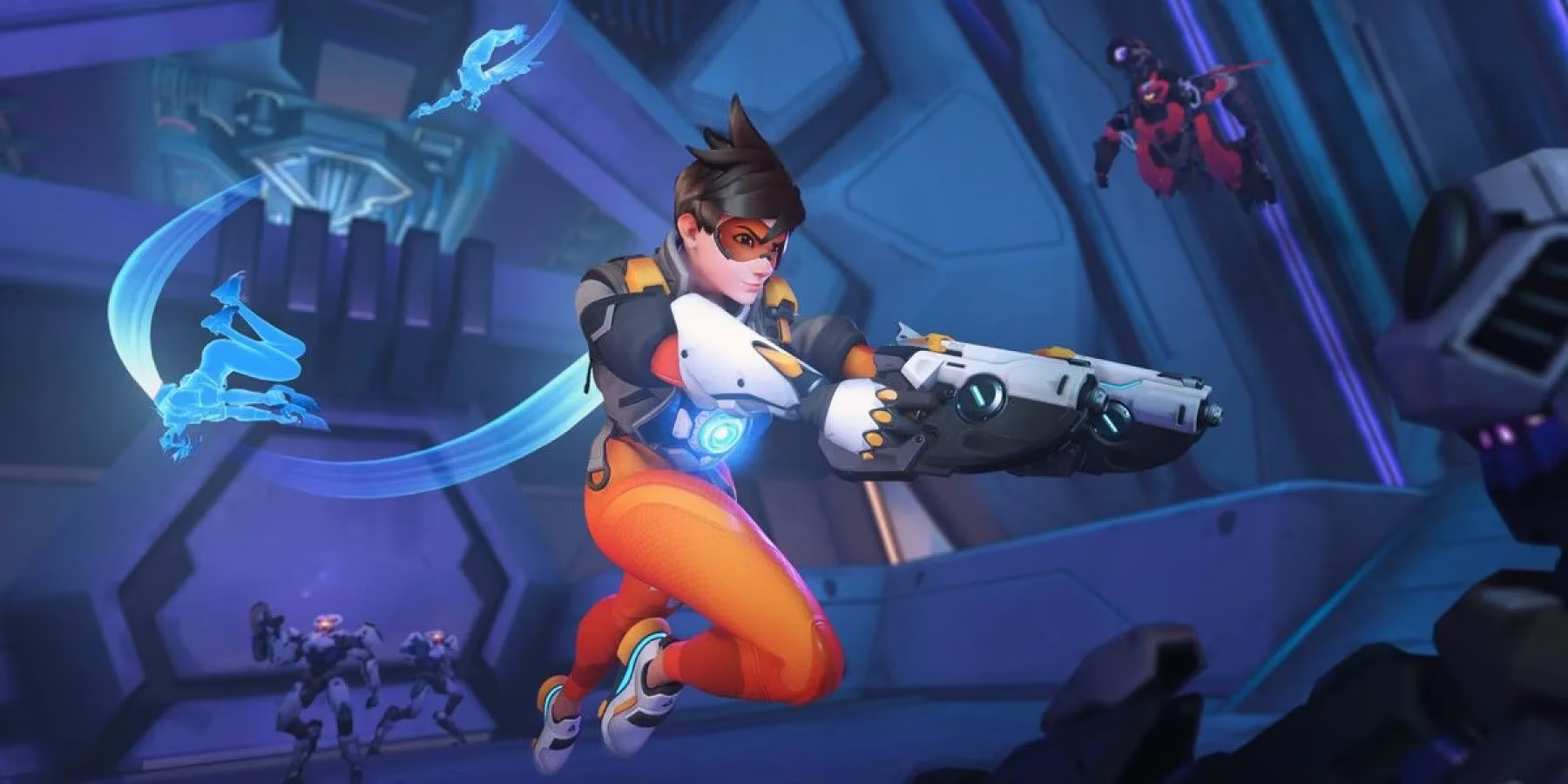
🎭 The Broken Promise: From Headliner to Afterthought
The story of Overwatch 2's PvE is one of diminishing returns. When the sequel was announced in 2019, the Story Missions were positioned not as a side attraction but as a core reason for the game's existence. Fast forward to 2026, and the landscape is starkly different. The three missions released in 2024's Season 6—"Liberation," "Ironclad," and "Enigma"—were meant to be the first course of a grand narrative feast. Instead, they may have been the last.
Former developers, speaking anonymously, revealed that these initial missions "did not do well at all," both in player engagement and as a financial venture. This poor reception created a negative feedback loop within the studio, reinforcing pre-existing doubts about the viability of large-scale PvE content in a game whose soul is fundamentally competitive.
⚙️ The Core Design Dilemma
At the heart of the struggle was a fundamental mismatch. Overwatch's heroes are meticulously crafted for the ballet of player-versus-player combat—their abilities balanced for fleeting moments of counter-play and team synergy. Adapting these kits for a fight against predictable AI enemies was like trying to use a scalpel to chop down a tree; the tool was precise and elegant, but entirely unsuited for the task at hand.
-
Hero Kits: Abilities designed for outsmarting human opponents felt lackluster or overpowered against AI swarms.
-
Progression Systems: The promised talent trees and hero progression, key selling points of the original PvE pitch, proved enormously complex to implement in a balanced way.
-
Resource Allocation: Every hour spent solving PvE puzzles was an hour not spent on the live-service PvP content that drives the game's daily engagement and esports scene.
This created an internal tension. "Everybody still cared a lot about PvE," one source said, "but it really doesn't seem like, even from a business perspective, that Activision or Microsoft have any faith in it." The project became a ship caught between two storms, with leadership delivering conflicting messages of unwavering confidence and intense scrutiny over whether the content met the legendary, yet nebulous, standard of "Blizzard Quality."
💼 The Human Cost: Layoffs and Lost Expertise
The most devastating blow came with the corporate restructuring following Microsoft's acquisition. The January 2025 layoffs specifically targeted teams working on "events, PvE content, and narrative elements." One developer stated plainly, "If they're gonna make more of that stuff, they just laid off all the people who were working on it."
| Area Impacted | Consequence for PvE |
|---|---|
| Narrative Design | Loss of writers crafting the ongoing story arc. |
| Mission Design | Fewer designers building encounter layouts and objectives. |
| Systems Design | Reduced capacity for creating PvE-specific talent trees and rewards. |
| Event Integration | Harder to weave story missions into seasonal events. |
The layoffs severed the project's central nervous system. While the developers indicated that more missions existed in various states—from early concepts to fully playable prototypes—the institutional knowledge and passionate drive to complete them have been scattered.
🧭 A Future Adrift
The external signs are just as telling. In the Overwatch 2 client, the prominent "Missions" card on the main menu has been swapped out for the "Hero Mastery" mode, with the story campaign relegated to a small, easy-to-miss button. This UI change is a silent admission of shifting priorities, speaking louder than any official blog post.
The original plan, as understood by the development team, was to release a new set of three Story Missions every 18 months. That roadmap now appears as realistic as a chalk drawing in the rain. The combination of poor initial performance, profound development challenges, and the evisceration of the team tasked with building it has left the story of Overwatch 2's PvE in a state of permanent limbo.
For players invested in the lore of characters like Winston, Tracer, and the new antagonist, the Ramattra, this is a profound disappointment. The story missions offered a chance to see these heroes in a new light, to fight for a cause rather than just a control point. Their potential demise means the rich world-building may forever be relegated to animated shorts and comic books, never fully realized in interactive play.
The tale of Overwatch 2's PvE is a cautionary one about the clash between creative ambition and corporate reality. It's a story of a dream that grew too large for its foundations, becoming a mansion built on sand, slowly being swallowed by the tides of quarterly reports and restructuring. The heroes may still battle on in the arena, but their chance to star in their own epic saga seems to have slipped away, leaving behind only the echo of what was promised and the ghost of what might have been.