That Pachimari Charm Costs More In Overwatch 2 Than The Real Thing
Overwatch 2's Pachimari charm costs double the physical version, exposing the predatory in-game store and currency bundles.
You'd think a digital charm couldn't possibly cost more than a physical one you can hold in your hand, but Overwatch 2 seems determined to prove that logic wrong. I've been playing since the original launch, and honestly, the shift to free-to-play has been... rough. The store prices are the kind of thing that makes you do a double take, then immediately start doing mental math to confirm you're not going crazy. Well, that's exactly what one Redditor did, and the results are as absurd as they are predictable.
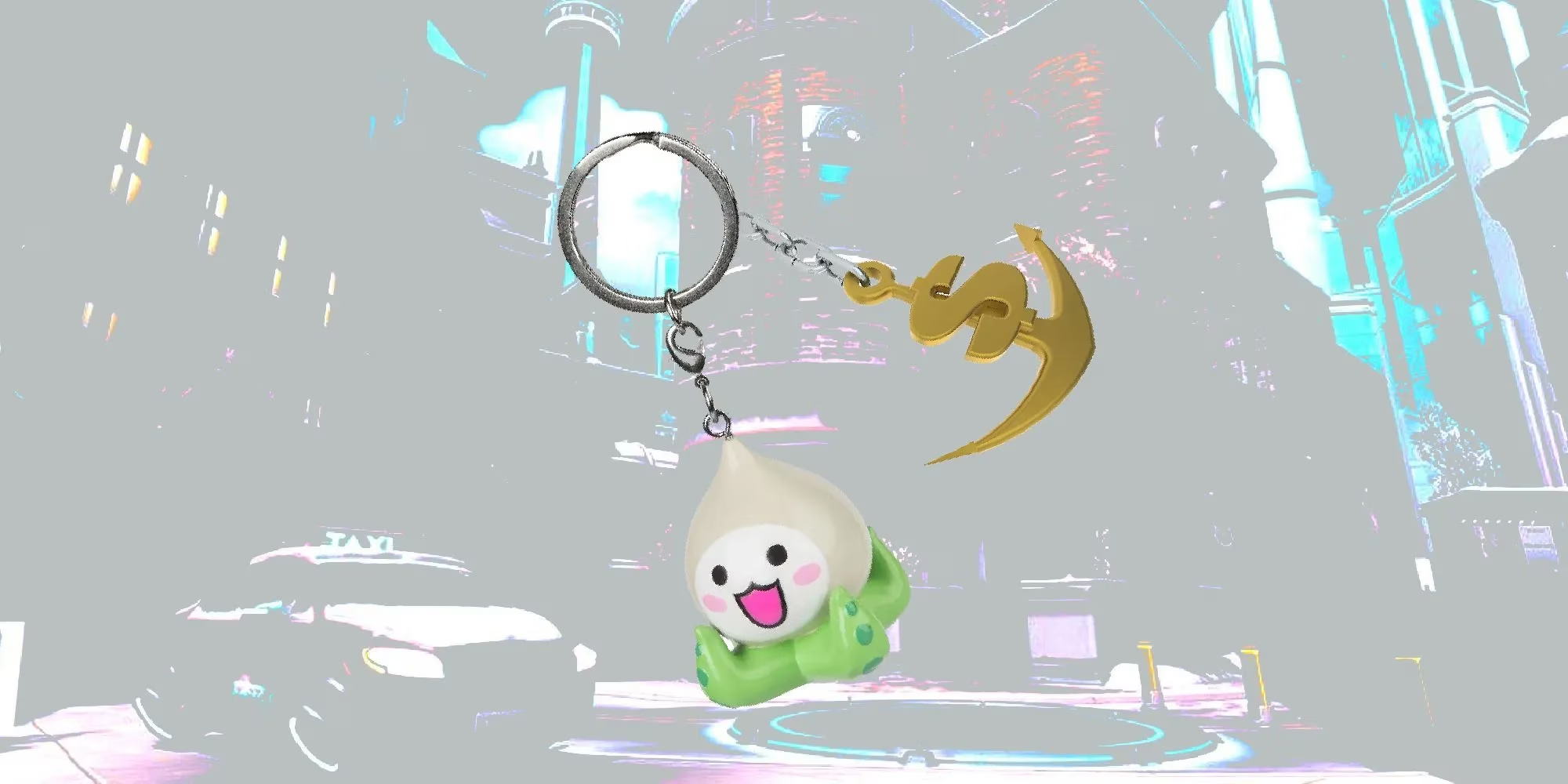
It all started when a user named hi_im_red_beard posted a simple comparison on the Overwatch subreddit. On one side, you've got the adorable Pachimari weapon charm available in the Overwatch 2 in-game store. On the other, the same Pachimari design sold as a real, physical charm on the Blizzard Gear Store. One costs $5, you can clip it to your bag, lose it under the couch, find it three years later. The other costs 700 Overwatch Coins. Simple enough, right? Let's break out the calculator because this is where things get stupid.
Right now, 1000 Overwatch Coins will set you back $10. That makes each coin worth roughly one cent. So 700 coins should be about $7. That's already $2 more than the real-life charm. But wait, it gets worse – you can't just buy 700 coins. The smallest coin pack you can grab is 500 coins for $4.99. Unless you've got some leftover currency from a previous battle pass grind, you're forced to shell out for at least the 1000-coin bundle. That's a cool ten bucks just to get enough virtual currency for a virtual trinket, which is double the real world price. Even if you go for the mega bulk pack – 11,600 coins for $99.99 – the per-coin discount still leaves that Pachimari charm above $6. PCGamesN crunched those numbers ages ago, and the math holds up today: you're always paying a premium for pixels.
Things aren't much better if you're across the pond. In the UK, the real Pachimari charm goes for about £8, while the in-game version technically values at around £5.87 based on coin bundles. But the minimum spend to actually acquire it pushes your real spend near a tenner. It's the same sneaky trick every free-to-play game pulls – the conversion rates are designed so you always have leftover currency, and the next shiny thing always seems just out of reach without another top-up.
You can't talk about this topic without bringing up the sheer irony of the community's sentiment. Overwatch 2's monetization has players genuinely missing loot boxes. Let that sink in. The system that once sparked so much outrage for being predatory gambling is now looked back on fondly because at least you could earn cosmetics through gameplay without opening your wallet for every single item. When a simple charm ignites over 46,000 upvotes on Reddit, you know the frustration runs deep. That post isn't just a fluke; it's the community collectively facepalming at the state of things.
What really grinds my gears is how this tiny Pachimari situation is a perfect snapshot of the larger problem. Legendary skins often sit in the shop for $20 or more. Seasonal events that used to reward dedicated players now gate most rewards behind premium event passes. If a charm – arguably the least necessary cosmetic in the game – carries such a ridiculous markup, what does that say about the rest of the store? It tells us that the pricing isn't anchored to value or effort; it's anchored purely to what they think they can get away with. And judging by the continued high prices haven't gone down, they're getting away with plenty.
Is Overwatch 2 alone in this madness? Of course not. We've seen similar stories in Apex Legends, Valorant, and Diablo Immortal. But for a franchise that built its reputation on polished, player-friendly design, the shift has been jarring. The Pachimari charm debate might seem like a minor squabble over pocket change, but it's emblematic of a shift that treats your wallet as the primary progression system. I'll keep playing because the core gameplay is still fantastic, but every time I look at the store I'm reminded that somewhere out there, a real-life Pachimari charm is laughing at my digital one – and it cost less, too.